AI Agents for Insurance: Move from Pilot to Production
AI agents for insurance can automate claims, underwriting, and service safely. Learn workflows, guardrails, KPIs, and a 90-day rollout plan.

AI agents for insurance are no longer just an innovation-lab experiment. Carriers, brokers, MGAs, and claims organizations are now asking a more practical question: how do we move AI automation from impressive demos into production workflows that are safe, measurable, and compliant? Insurance is built on the work AI agents are good at supporting: reading documents, checking rules, extracting data, routing exceptions, summarizing evidence, and recommending next steps. The goal is not to replace insurance professionals. The goal is to give them reliable AI coworkers that handle repetitive work, surface the right evidence, and escalate decisions that require judgment, empathy, or regulatory care.
What Are AI Agents for Insurance?
AI agents are software systems that complete multi-step tasks using data, tools, and business rules. Unlike a basic chatbot that only answers questions, an AI agent can take action inside a workflow.
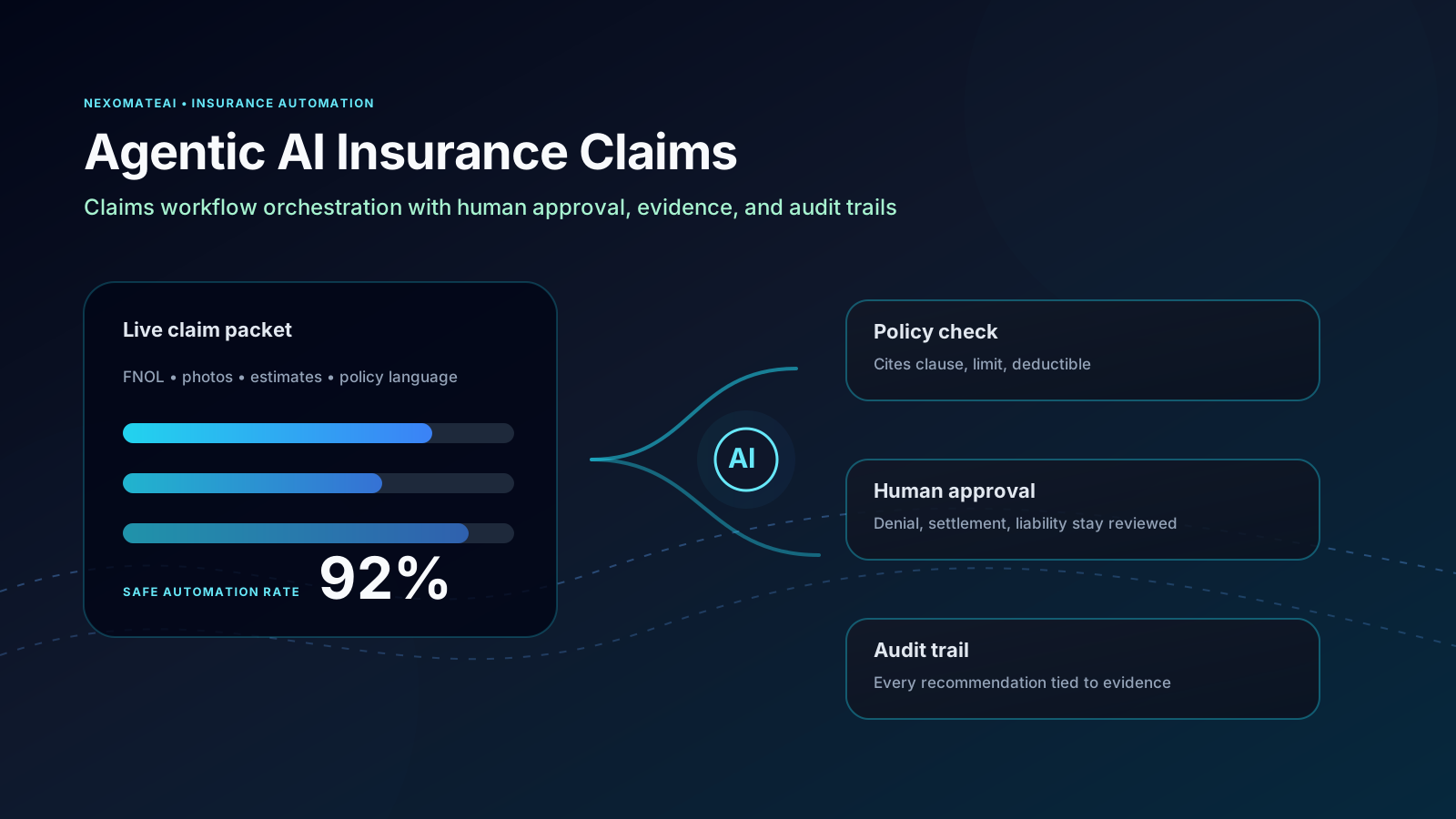
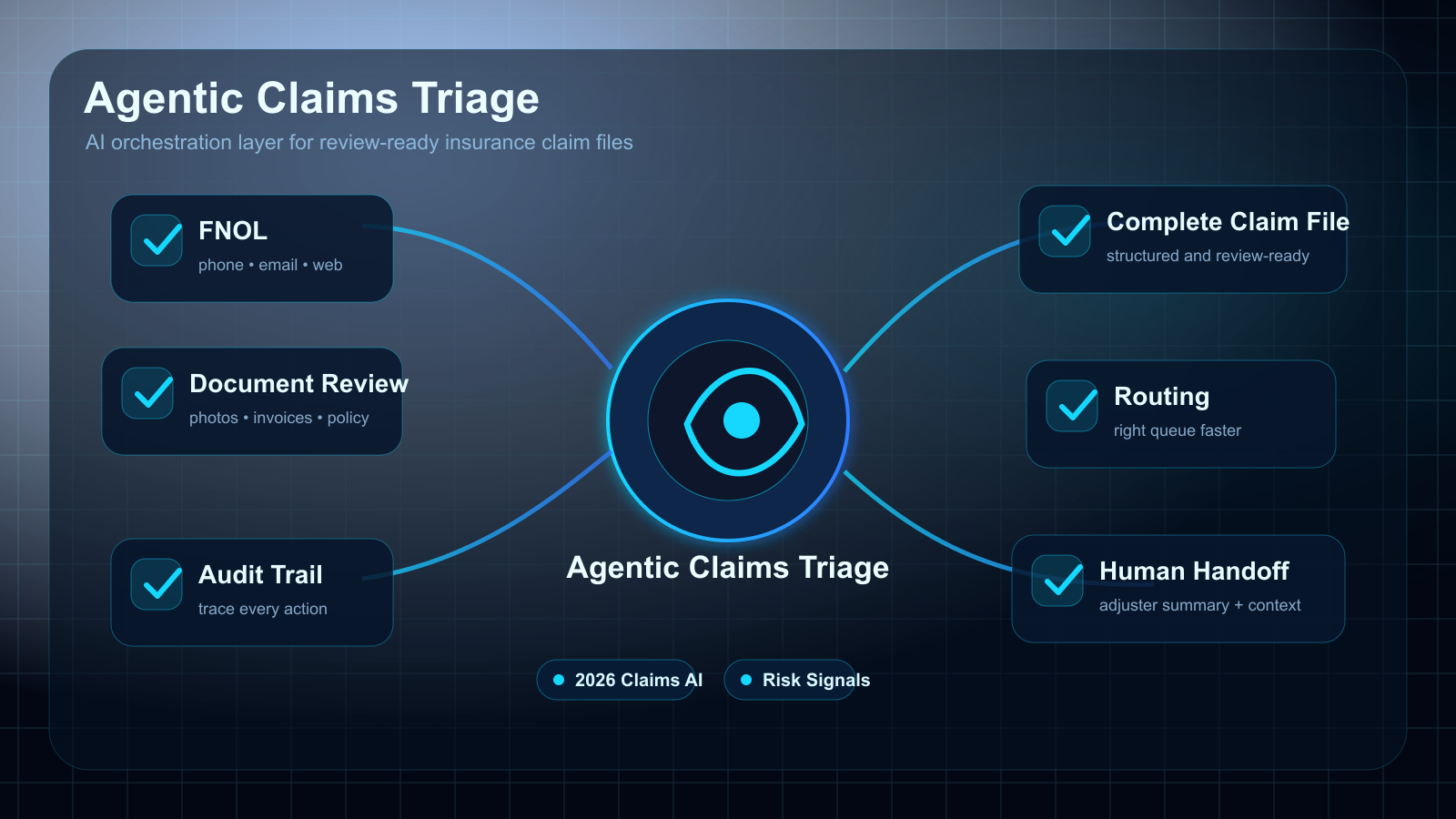
For example, an insurance AI agent might read a first notice of loss email, extract the policyholder and incident details, check whether required documents are missing, compare claim details against policy rules, summarize evidence for an adjuster, recommend routing based on severity and confidence, and create an audit trail of what it reviewed.
The best production systems usually combine workflow automation, document AI, predictive models, generative AI, and human-in-the-loop review.
Why Claims Is the Best First Use Case
Claims is often the strongest starting point for AI insurance automation because it is high-volume, document-heavy, and customer-sensitive. Many claims workflows contain repetitive tasks that slow adjusters down but do not always require expert judgment.
Claims workflows where AI agents can help now include first notice of loss intake, document classification, coverage pre-checks, severity triage, customer updates, and adjuster summaries. The common thread is not AI replacing the adjuster. It is AI preparing the file so the adjuster can decide faster and with better context.
A Practical Claims AI Agent Workflow
A production-ready claims AI agent should have a defined operating model. It receives the claim from forms, emails, call transcripts, or portal submissions. It extracts structured data such as claimant details, policy number, loss date, loss type, location, involved parties, and documents received. It validates whether the policy is active, whether required fields are missing, and whether the claim appears duplicate.
Then it classifies complexity, recommends the next action, drafts communication for approval, and logs the rationale. That last step is essential. In insurance, automation without an audit trail is a risk. Production AI needs to be explainable enough for operations, compliance, and regulators to understand what happened.
Underwriting Automation With AI Agents
Underwriting is another high-value area, especially for commercial lines, specialty insurance, and complex submissions. Underwriters often spend too much time gathering and rekeying information before they can apply judgment. AI agents can extract data from ACORD forms, PDFs, emails, spreadsheets, and loss runs; compare submissions against appetite guidelines; pull third-party risk data; identify missing information; summarize prior claims and exposure changes; prepare quote recommendations; and flag unusual risks for senior review.
A strong underwriting AI agent does not make unbounded decisions. It operates within clear authority levels and escalates cases involving unusual exposures, missing information, or risks outside appetite.
The Four Guardrails Production AI Agents Need
The biggest gap in many AI insurance pilots is governance. A demo can look impressive with a few sample documents. Production requires controls.
First, set confidence thresholds for auto-complete, human approval, and escalation. Second, design human-in-the-loop checkpoints for coverage disputes, large losses, injury claims, fraud referrals, declines, customer complaints, and low-confidence AI recommendations. Third, maintain audit trails that record input documents, extracted data, rules applied, model output, confidence score, human approvals, and final action. Fourth, ground every agent in approved sources: policy language, underwriting guidelines, claims procedures, state-specific rules, and compliance requirements.
KPIs That Prove AI Insurance Automation Is Working
Speed matters, but it is not the only metric. A good AI automation program should measure operational, financial, customer, and compliance outcomes.
Track claim cycle time, first-contact resolution, touchless or low-touch claim rate, adjuster caseload capacity, underwriting turnaround time, submission-to-quote ratio, rework rate, leakage reduction, fraud referral precision, customer satisfaction, complaint rate, compliance exception rate, and human override rate.
The human override rate is especially useful. If staff frequently reject AI recommendations, the model, rules, or workflow design need improvement. If overrides are rare but customer complaints increase, the automation may be moving too fast without enough empathy or context.
A 30/60/90-Day Rollout Plan
Days 1-30: choose one process with high volume, measurable pain, and manageable risk. Good candidates include claims document intake, FNOL summarization, missing-document requests, submission intake, underwriting appetite checks, and customer service knowledge retrieval. Map the current workflow, systems, handoffs, exception types, and decision points.
Days 31-60: build a controlled pilot with human review. Connect only the systems and data required. Define confidence thresholds, escalation rules, and audit logging from the start. Measure time saved per file, extraction accuracy, staff acceptance, override patterns, missing data issues, and customer communication quality.
Days 61-90: move toward production by expanding gradually. Add more document types, claim categories, or underwriting segments. Before full deployment, confirm compliance sign-off, security review, data retention rules, model monitoring, exception reporting, business owner accountability, and a rollback plan.
Build vs. Buy: How to Decide
Insurance teams have three main options. Buying an insurance-specific platform is often best when you need faster deployment, prebuilt workflows, and integrations with claims, policy, or document systems. Look for insurance-specific data models, audit trails, configurable rules, human review queues, core system integrations, security certifications, and explainability features.
Building a custom AI agent makes sense when the workflow is proprietary, deeply integrated, or a source of competitive advantage. A hybrid approach is often the most practical path because insurance operations rarely fit neatly inside one system.
Conclusion
AI agents for insurance will create the most value when they are treated as operational systems, not experiments. The winning insurers will not simply deploy more chatbots. They will redesign claims, underwriting, and service workflows around governed AI assistance. Start with a document-heavy process. Add human-in-the-loop controls. Measure outcomes that matter. Build auditability from day one. Then expand from simple assistance to more advanced AI insurance automation.
Plan Your Insurance AI Agent Rollout
Want to move from AI pilot to production safely? Book a NexomateAI automation audit and we will map the first workflow, guardrails, and 90-day rollout plan.
How Insurance Agencies Book 3X More Meetings with Multi-Channel Prospecting Automation
Single-channel prospecting yields just 8% response rates. Multi-channel automation combines email, LinkedIn, and phone to generate 3X more meetings with 45% higher response rates.
Agentic Claims Triage: How AI Automation Is Reshaping Insurance Claims in 2026
Agentic claims triage helps insurers automate FNOL, document review, routing, and adjuster handoffs while keeping humans in control.
Related Articles
Continue learning about insurance automation
Get More Insurance Automation Insights
Join 500+ insurance agency owners receiving weekly automation tips, ROI calculators, and industry insights.
No spam. Unsubscribe anytime.