Agentic Claims Triage: How AI Automation Is Reshaping Insurance Claims in 2026
Agentic claims triage helps insurers automate FNOL, document review, routing, and adjuster handoffs while keeping humans in control.
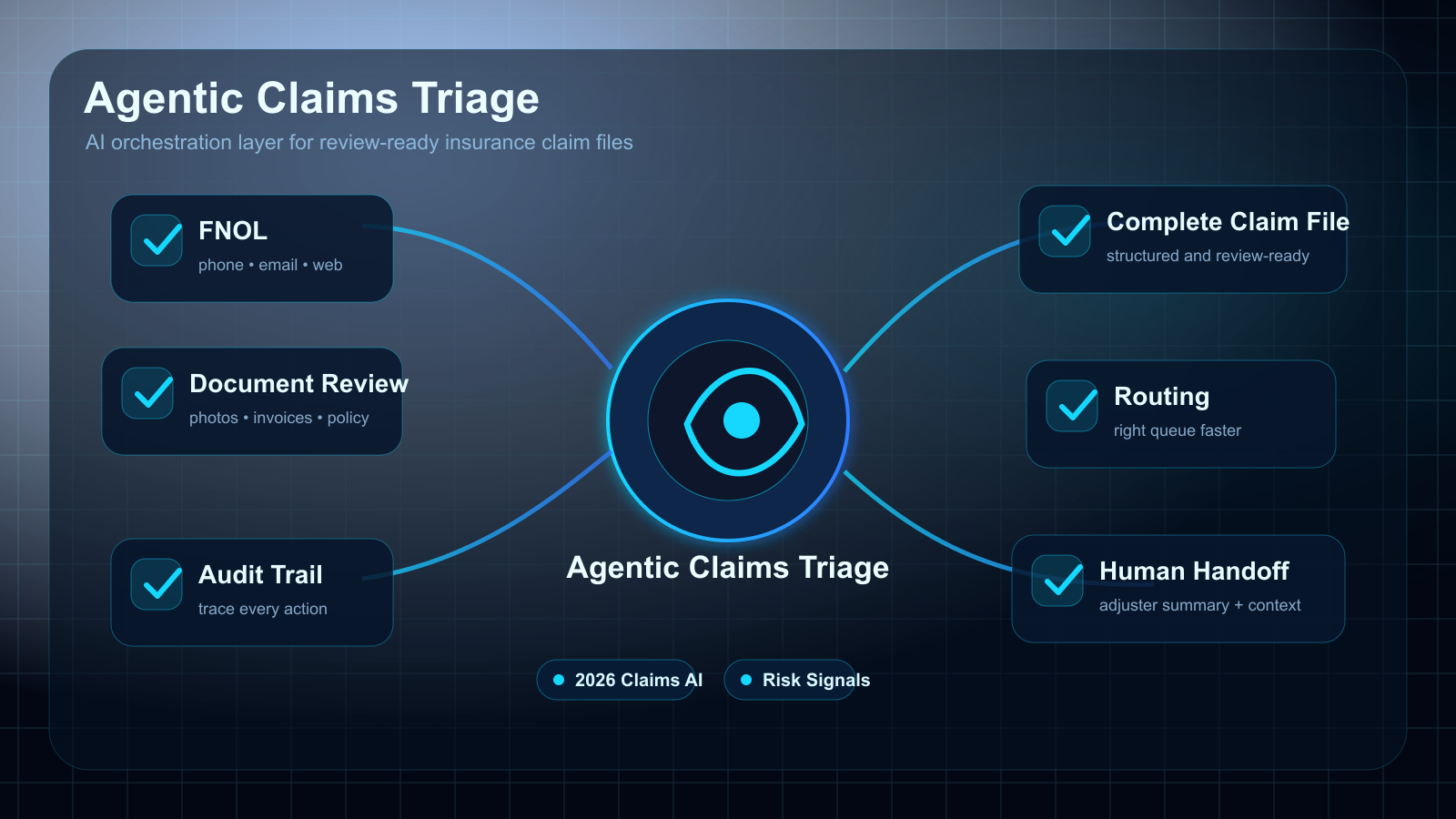
Insurance automation is entering a new phase in 2026. The conversation is no longer just about chatbots answering policy questions or OCR tools reading documents. The real shift is agentic claims triage: AI systems that can intake a claim, collect missing information, extract structured data, check business rules, route the case, and hand it to the right human with context.
That matters because claims are still one of the most expensive, emotional, and operationally messy parts of insurance. A customer might report damage by phone, email, web form, WhatsApp, app upload, or broker message. The supporting documents may arrive in pieces. The policy system may be old. The fraud rules may live in a different workflow. And the adjuster often starts with an incomplete file.
Agentic claims triage does not magically remove that complexity. But it can coordinate the first layer of work faster than a traditional automation stack. Instead of using one tool for document extraction, another for routing, another for customer communication, and another for summarization, insurers can deploy AI agents that orchestrate the process end to end.
What Is Agentic Claims Triage?
Agentic claims triage is the use of AI agents to manage the early stages of an insurance claim. The agent does not simply respond to a prompt. It works toward a goal: create a complete, review-ready claim file and route it correctly.
A claims triage agent may collect first notice of loss details, extract policyholder and incident information, read uploaded photos or invoices, identify missing documents, ask follow-up questions, check coverage indicators, detect conflicts in the claim story, apply routing rules, flag potential fraud or SIU review, summarize the file for an adjuster, and create tasks inside the claims management system.
The important difference is orchestration. Traditional automation usually handles one narrow action. Agentic automation connects multiple actions into a workflow.
Why Insurance Claims Are Ready for Agentic AI
Claims teams are under pressure from both sides. Customers expect fast digital service, while carriers need accuracy, compliance, and cost control. A slow claim damages customer trust. A rushed claim increases leakage, fraud exposure, and regulatory risk.
This makes claims triage a strong use case for AI automation because it contains many high-volume, repeatable tasks that still require judgment at the edges. Many claims do not need a senior adjuster at the first step. They need clean intake, document capture, eligibility checks, prioritization, and routing.
If an AI agent can prepare that information before a human opens the file, the adjuster spends less time searching and more time deciding. That is the right role for AI in insurance: not replacing expert judgment, but removing the manual drag around it.
The 2026 Shift: From Chatbots to Orchestrators
In earlier insurance automation projects, most AI tools were limited to front-office chat or back-office extraction. A chatbot answered FAQs. A document AI model extracted fields. A workflow tool moved the case to the next queue.
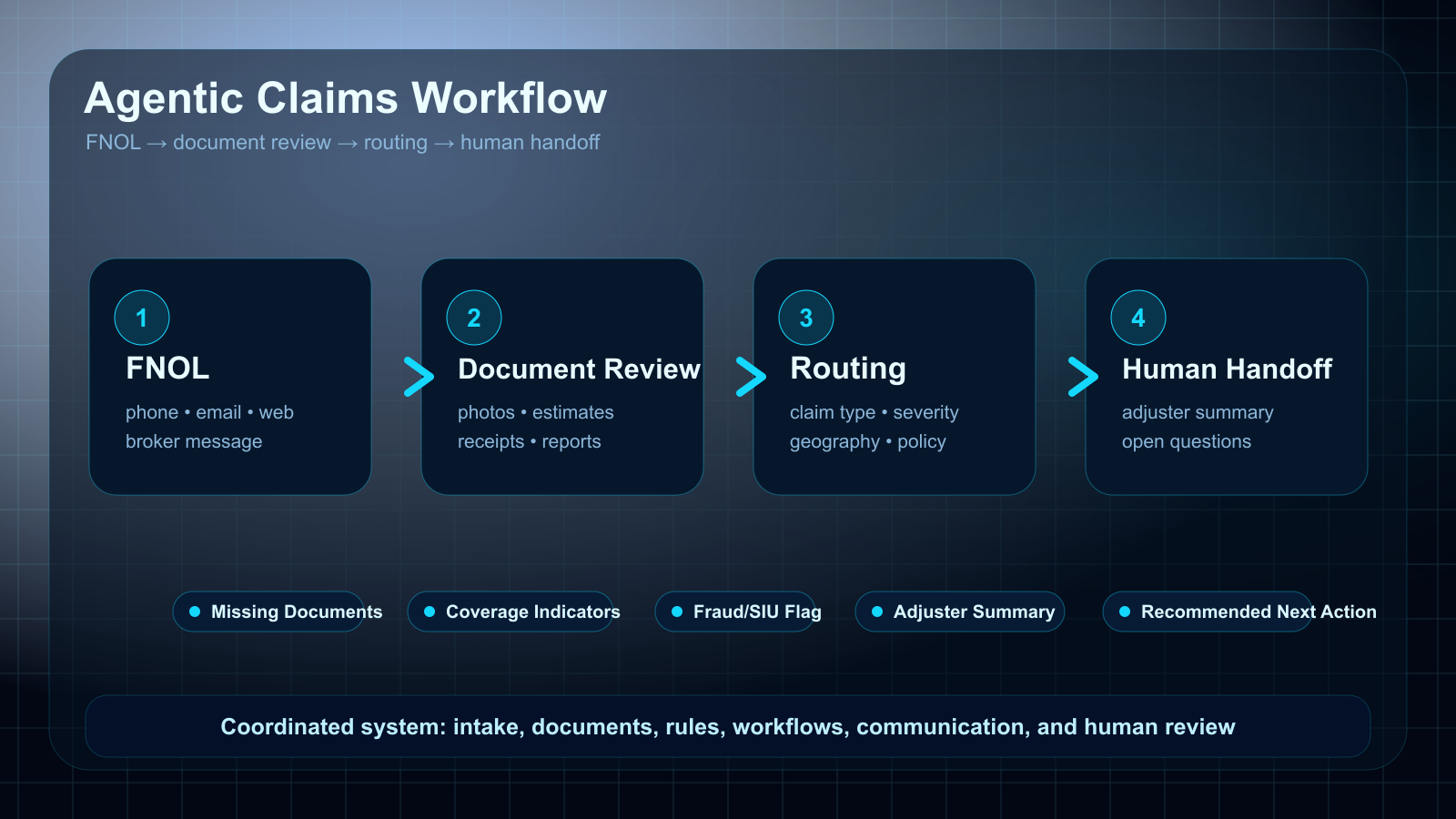
Agentic AI combines these capabilities into a coordinated system. A modern agentic claims workflow may capture a claim through voice, chat, email, or web form; check required fields; extract information from photos, estimates, receipts, police reports, or medical documents; compare the claim against policy and coverage indicators; identify missing information; score urgency and complexity; route the claim to the right queue; and create a concise handoff summary with evidence, open questions, and recommended next steps.
This is why agentic claims triage is becoming more valuable than standalone AI tools. The business value is not only in better text generation. It is in faster coordination.
Practical Use Cases for Agentic Claims Triage
First notice of loss is one of the best starting points for insurance automation. It is structured enough to automate, but messy enough to benefit from AI. A claims intake agent can ask natural follow-up questions, capture the timeline of the incident, collect contact details, identify involved parties, and convert the conversation into a structured claim record.
Document review is another high-impact use case. Claims often involve PDFs, scanned forms, repair estimates, invoices, photos, emails, and customer messages. A good claims automation system does not dump extracted text into a dashboard. It turns documents into structured claim intelligence: date of loss, claimed amount, policy number, claimant identity, incident description, supporting evidence, missing documents, conflicting details, and payment or reserve indicators.
Routing is where many claims operations lose time. Agentic claims triage can apply routing logic based on claim type, severity, geography, policy details, customer segment, documentation quality, and risk signals. The goal is not to let AI make final settlement decisions. The goal is to get the right claim to the right path faster.
Human Handoff Summaries Reduce Adjuster Load
One of the most underrated benefits of agentic AI is the handoff summary. When a human adjuster opens a file, they should not have to reconstruct the entire story from scattered notes and documents.
The AI agent can summarize what happened, who is involved, what has been verified, what is missing, what seems inconsistent, which documents were reviewed, which rules were triggered, and the recommended next action.
This reduces cognitive load and improves consistency across teams. It also gives managers a clearer view of where files are stuck and which exceptions need attention.
Customer Communication Without Losing Control
Claims are stressful for customers. Silence creates frustration. But claims teams often struggle to send timely updates because they are buried in manual work.
AI agents can send status updates, request missing documents, explain next steps, and answer simple process questions. The best systems keep communication grounded in the actual claim file and escalate sensitive questions to a human.
This can improve customer experience without sacrificing control. The key is to define which messages the agent can send automatically, which drafts need approval, and which situations must always be escalated.
What Insurers Must Get Right Before Deploying Agentic AI
Agentic claims triage has real potential, but insurers should not treat it as a plug-and-play magic layer. Claims are regulated, sensitive, and financially material. The system design matters.
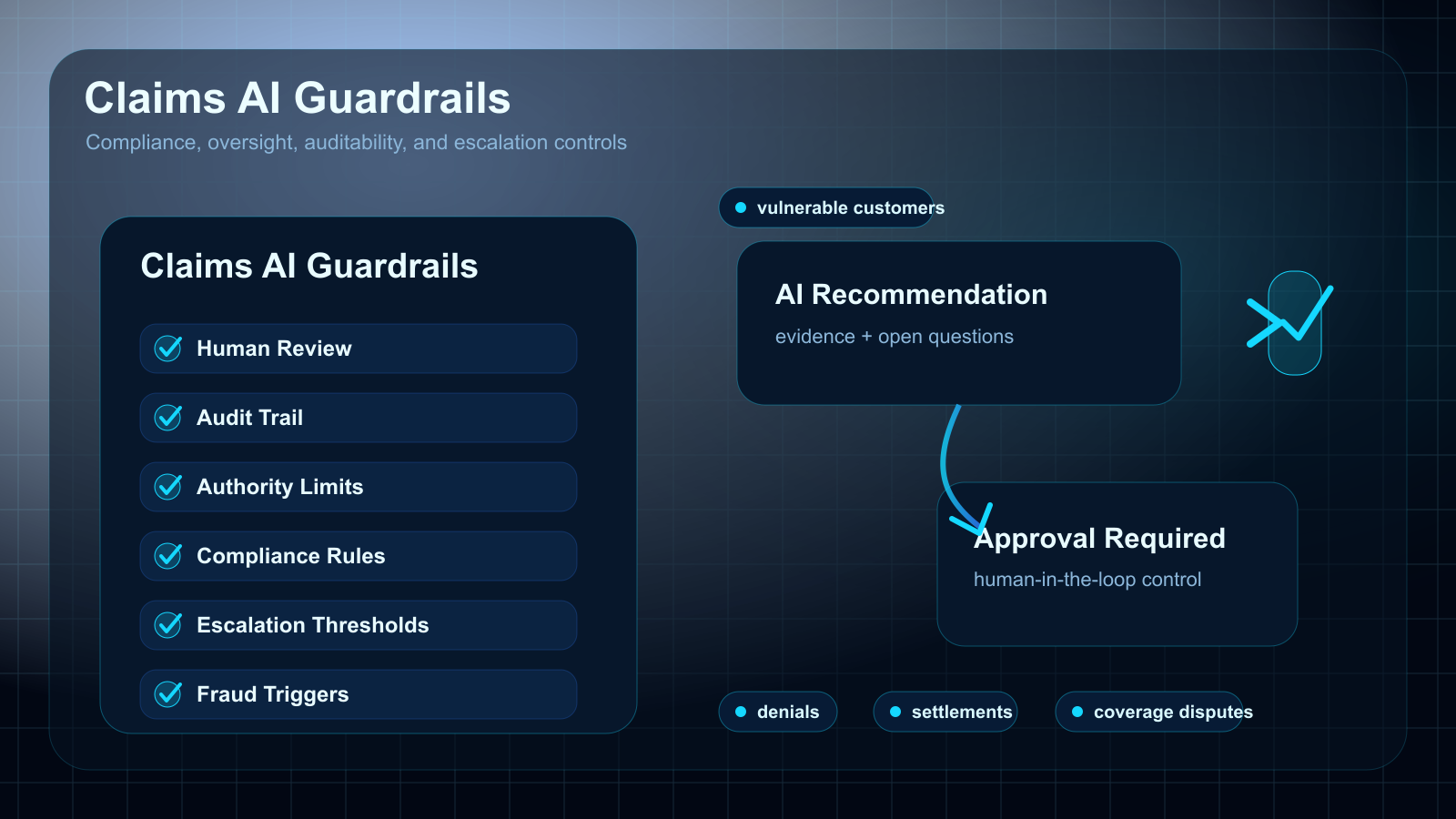
AI should support claims professionals, not silently make high-impact decisions without review. Human oversight is especially important for denials, settlement recommendations, fraud escalation, coverage disputes, and vulnerable customers.
Every AI action in a claims workflow should be traceable. Insurers need to know what the agent reviewed, what it extracted, what rule it applied, what recommendation it made, and when a human approved or changed the outcome. Auditability protects the insurer, the customer, and the claims team.
The strongest systems combine AI flexibility with rule-based guardrails. Coverage checks, authority limits, compliance rules, escalation thresholds, and fraud triggers should not rely only on model confidence.
Start Narrow, Then Expand
Most insurers cannot rip out their policy admin, claims management, CRM, document management, and payment systems. Agentic AI needs to work with existing infrastructure through APIs, secure connectors, workflow queues, identity controls, and clear fallback paths.
The best starting point is not automate all claims. It is a focused workflow with measurable outcomes. Good first projects include auto FNOL intake, property claim document collection, low-complexity claim triage, broker-submitted claim normalization, missing document follow-up, and adjuster handoff summaries.
Once the process is stable, insurers can expand to more lines, more claim types, and deeper integrations.
Metrics That Matter
To judge whether agentic claims triage is working, insurers should track business outcomes, not just AI accuracy. Useful metrics include average FNOL completion time, time from claim submission to first human review, percentage of claims routed correctly, missing document rate, adjuster time spent on intake review, customer response time, straight-through processing rate, reopen rate, escalation accuracy, complaint rate, claim leakage indicators, and audit exception rate.
A claims AI agent should be measured like an operations system, not a demo. If the metrics do not improve, the workflow needs to be redesigned before expanding automation.
The Business Case for Agentic Claims Triage
The business case is strongest where claims volume is high, intake is repetitive, and adjusters spend too much time preparing files instead of resolving them. Agentic claims triage can reduce cost by automating manual intake and document handling. It can improve speed by routing claims earlier. It can improve quality by standardizing summaries and checklists. It can improve customer experience by reducing silence and repeated questions.
But the biggest advantage may be capacity. Claims teams do not need AI because they lack talent. They need AI because skilled adjusters are spending too many hours on administrative friction. If agentic automation gives adjusters more time for judgment, negotiation, empathy, and complex decision-making, the whole claims operation improves.
The Future of Insurance Automation Is Coordinated
The next wave of insurance automation will not be defined by isolated AI features. It will be defined by coordinated agent systems that connect intake, documents, rules, workflows, communication, and human review.
Agentic claims triage is a practical example of that shift. It does not require insurers to replace every core system. It does not require full autonomy. It does not require removing humans from the process.
It requires a better operating layer: one that can understand messy inputs, take structured actions, follow rules, escalate uncertainty, and prepare better files for human experts. For insurers, MGAs, brokers, and claims administrators, 2026 is the right time to move beyond chatbot experiments. The opportunity is not just to answer questions faster. It is to make the claims process itself faster, cleaner, and more reliable.
Conclusion
Agentic claims triage is where practical insurance AI starts. The safest path is not full autonomy. It is a governed workflow that prepares better claim files, routes work faster, keeps customers informed, and gives adjusters cleaner context for decisions. Start with one measurable claims workflow, add human-in-the-loop controls, build auditability from day one, and expand only after the operational metrics prove the system is helping.
Map Your Claims Triage Automation Plan
Want to see where agentic claims triage could save time in your claims workflow? Book a NexomateAI automation audit and we will map the first use case, guardrails, and rollout plan.
AI Agents for Insurance: Move from Pilot to Production
AI agents for insurance can automate claims, underwriting, and service safely. Learn workflows, guardrails, KPIs, and a 90-day rollout plan.
Agentic AI Insurance Claims: 2026 Automation Guide
Learn how insurers can deploy agentic AI insurance claims automation safely, with workflows, governance controls, ROI metrics, and a 90-day rollout plan.
Related Articles
Continue learning about insurance automation

Get More Insurance Automation Insights
Join 500+ insurance agency owners receiving weekly automation tips, ROI calculators, and industry insights.
No spam. Unsubscribe anytime.