Agentic AI Insurance Claims: 2026 Automation Guide
Learn how insurers can deploy agentic AI insurance claims automation safely, with workflows, governance controls, ROI metrics, and a 90-day rollout plan.
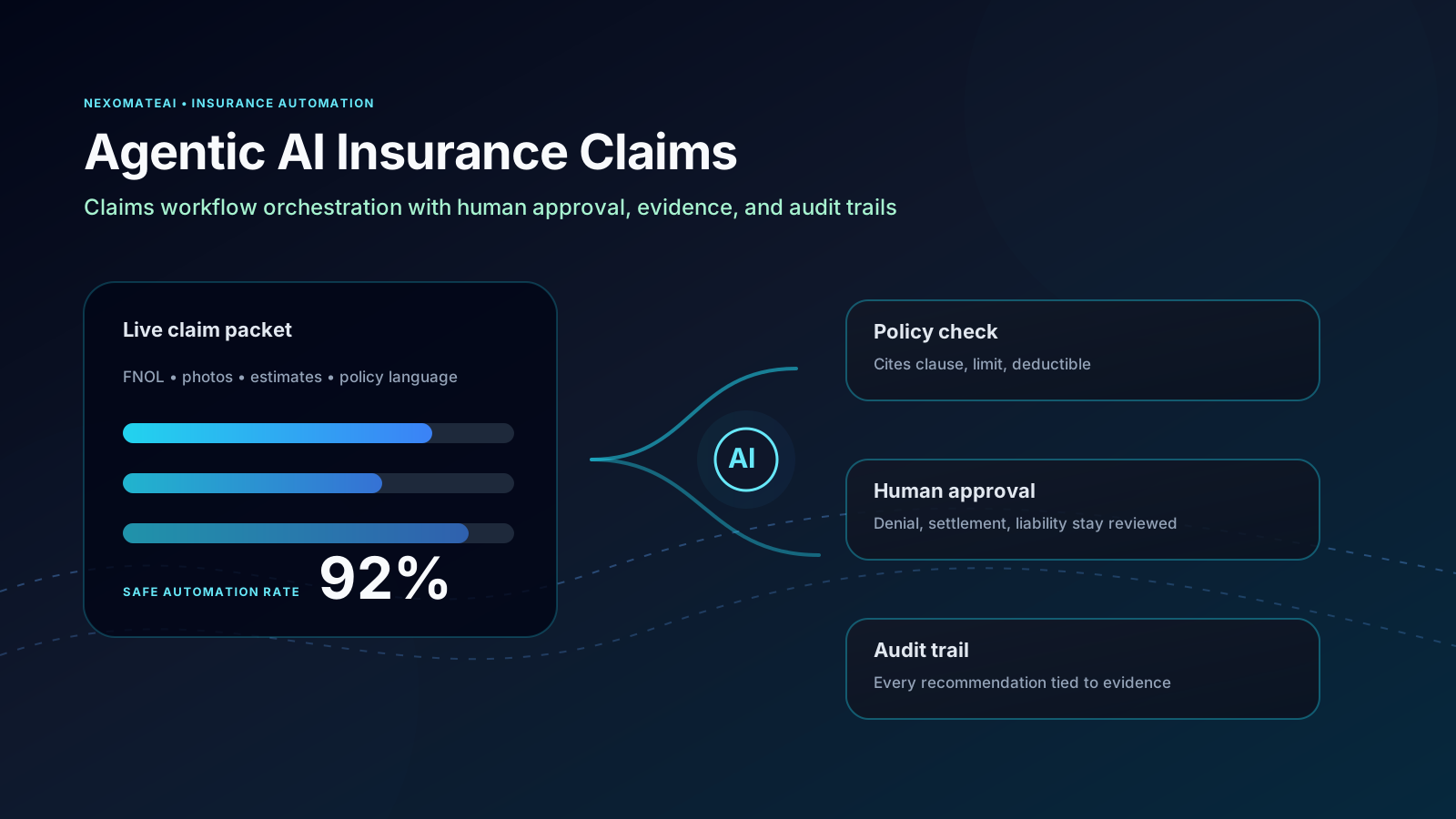
Agentic AI insurance claims automation is moving from pilots to production because claims teams face two pressures at once: settle faster and explain every decision. Rules engines help with simple routing. Generative AI helps with summaries. Agentic AI goes further by coordinating tools, checking policy language, gathering evidence, and recommending the next best action with a human reviewer in control.
The opportunity is not to replace adjusters. It is to remove the repetitive work that slows them down: reading duplicate documents, chasing missing information, applying obvious coverage checks, updating customers, and preparing claim files for review. This guide shows where insurance AI agents fit, how to launch safely, and what metrics to use before scaling.
Why Agentic AI Insurance Claims Are Moving From Pilot to Platform
The insurance market has crossed an important line. Carriers and vendors are no longer talking only about chatbots or OCR; they are packaging AI agents into claims, underwriting, customer service, and operations workflows. For claims leaders, that trend creates urgency and risk. Competitors can use AI claims automation to reduce cycle time and improve responsiveness. But a poorly governed agent can repeat the same mistake across thousands of files.
The winning approach is a controlled operating model: agents perform bounded tasks, humans approve high-impact decisions, and every recommendation leaves an audit trail.
What Agentic AI Means in Claims Processing
Agentic AI is software that can plan and execute multi-step work across systems. In claims processing automation, an agent might read the notice of loss, request missing photos, compare policy limits, check repair estimates, summarize medical notes, flag fraud indicators, and prepare a recommendation for an adjuster.
That is different from a static rules engine. Rules engines follow explicit if-this-then-that logic. Agentic systems can adapt their path based on context while staying inside guardrails. It is also different from a simple copilot. A copilot waits for a user prompt. A claims agent can monitor a queue, notice that a task is ready, assemble the evidence, and move the claim to the next review stage.
The key design question is: what should the agent do without approval? A safe first answer is preparation, not judgment. Let the agent collect, classify, summarize, validate, and route. Require human approval for denial, settlement, liability, reserve changes, or any decision that affects customer outcomes.
Best Use Cases for AI Claims Automation
First notice of loss is ideal for agentic AI because it is document-heavy and time-sensitive. An intake agent can classify the claim type, extract facts, detect missing information, create the claim record, and route it by severity. For auto claims, it might ask for photos and police reports. For property claims, it might request date-of-loss details, damage descriptions, and proof of ownership.
Claims teams also spend a large share of their day reading PDFs, emails, photos, invoices, repair estimates, medical records, and adjuster notes. Insurance automation tools can summarize these inputs, identify contradictions, and generate a clean chronology.
The strongest early use cases are:
- FNOL triage and completeness checks
- Document intelligence and claim file summaries
- Coverage checklist preparation with policy citations
- Fraud and severity routing for specialist review
- Customer and broker status-update drafting
A Practical Operating Model for Agentic AI Insurance Claims
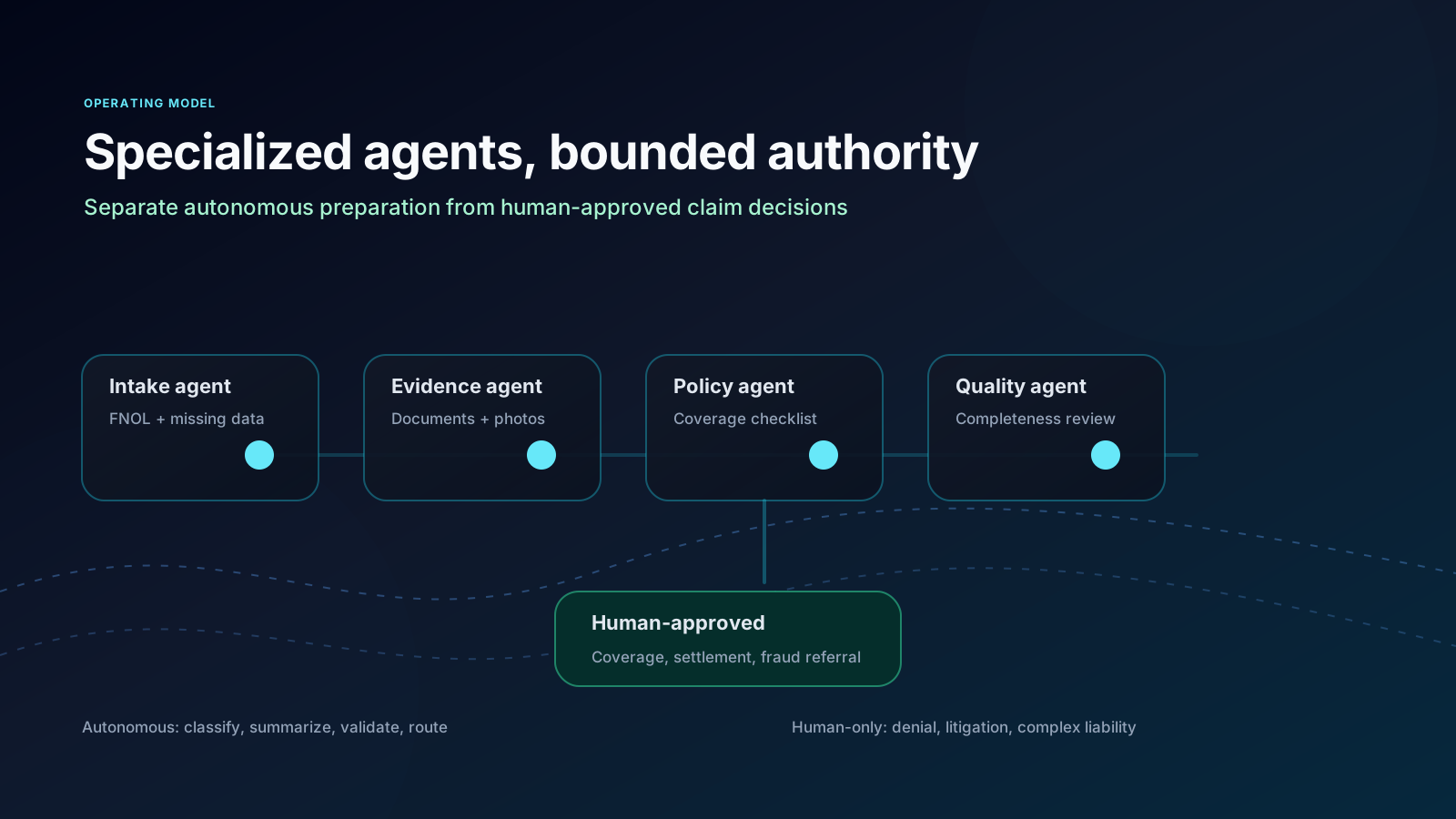
The most successful programs do not start with one giant agent. They start with specialized agents, each with a narrow job. An intake agent validates FNOL details and creates a complete claim packet. An evidence agent collects documents, photos, invoices, and third-party data. A policy agent checks coverage language and cites relevant clauses. A decision-support agent recommends next steps, reserve ranges, or settlement options. A quality agent checks completeness, compliance, and missing rationale before human review.
This structure is easier to test than a black-box system. If a recommendation is wrong, the team can see whether the issue came from extraction, policy interpretation, data access, or decision logic.
The operating model also needs permission levels: autonomous for classification and summarization, human-approved for coverage recommendations and settlement drafts, and human-only for denials, litigation decisions, complex liability judgments, and regulatory exceptions.
How to Start Without Creating Governance Risk
Agentic AI exposes the quality of the data beneath it. That should not stop carriers from moving; it should shape the first project. Start with one line of business and one workflow where data is available, outcomes are measurable, and risk is manageable. A property FNOL workflow, travel claim triage process, or health claims document review queue can work well. Avoid beginning with the most complex bodily injury or litigation-heavy claims.
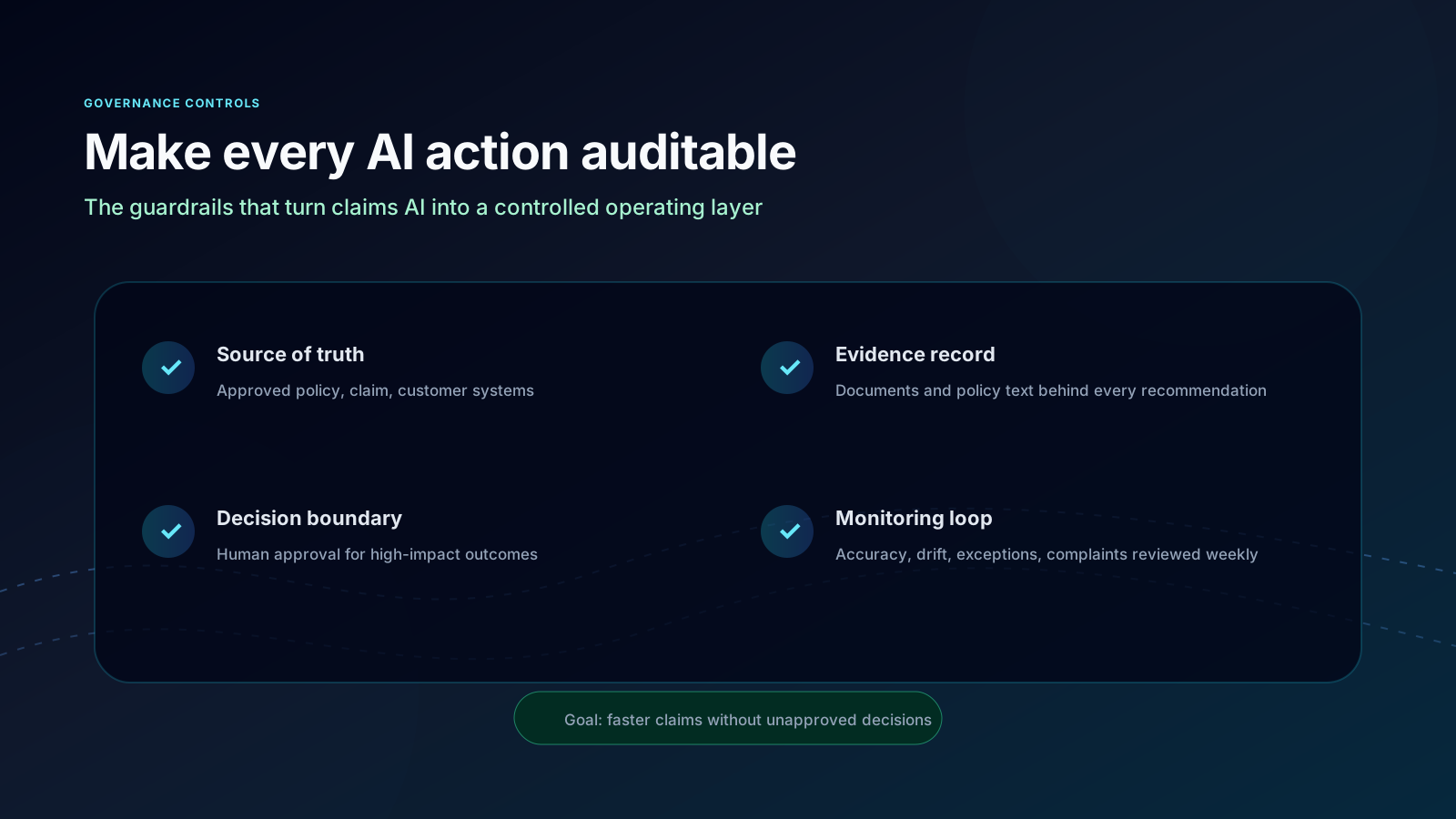
Before launch, define four controls:
- Source-of-truth control: the agent must pull policy, claim, and customer data from approved systems.
- Evidence control: every recommendation must include the documents, policy text, or data points used.
- Decision control: high-impact actions require licensed human approval.
- Monitoring control: claims managers review accuracy, exceptions, complaints, and drift weekly.
A 90-Day Rollout Plan
Days 1-15: choose one claim type, one queue, and one measurable problem. For example: reduce manual document review time for low-complexity property claims by 30% without increasing complaint rate. Map every system the agent needs: claims platform, document management, policy admin, CRM, payment systems, and communication tools.
Days 16-45: build the minimum useful agent. Do not try to automate the entire claim. Build one valuable workflow: FNOL completeness check, claim file summary, coverage checklist, or customer update drafting. Connect the agent to real documents and a sandbox or read-only claims environment.
Days 46-70: run the agent alongside the existing process. Compare its output to human work before changing production decisions. Track how often adjusters accept, edit, or reject recommendations. Capture why they reject them.
Days 71-90: scale only after setting thresholds, such as summary accuracy above 95%, routing accuracy above 90%, zero unsupported coverage citations, and documented human approval for all high-impact outcomes.
Metrics That Prove ROI
Claims automation should be measured in business outcomes, not model novelty. Track cycle time from FNOL to first contact, assignment, coverage review, and settlement. Measure the percentage of files prepared for adjuster review without manual document sorting. Monitor adjuster capacity, leakage reduction, customer response time, complaint rate, and compliance quality.
The most important metric is not automation rate by itself. The better metric is safe automation rate: the percentage of tasks completed by the agent within approved guardrails and accepted by reviewers.
Common Mistakes to Avoid
The first mistake is starting with technology instead of workflow. A powerful agent attached to a broken process will only accelerate confusion. Fix handoffs, data access, and authority levels first.
The second mistake is letting vendors define success. Platform launches are useful signals, but your claims environment is specific. Require proof on your documents, policies, state rules, customer segments, and adjuster workflows.
The third mistake is ignoring change management. Adjusters may resist AI if it feels like surveillance or replacement. Position the tool as an assistant that removes administrative burden. Show adjusters how their feedback improves the system. Give them easy override controls.
The fourth mistake is skipping legal and compliance input until the end. Bring compliance, claims leadership, IT security, data governance, and frontline adjusters into the design before production.
What Insurers Should Do Next
Agentic AI insurance claims automation is ready for practical adoption, but only when it is deployed as an operating model, not a magic layer on top of old workflows. Start with bounded tasks. Keep humans accountable for high-impact decisions. Measure safe automation, not just speed. Build audit trails from day one.
For insurers, MGAs, and claims organizations, the next step is simple: choose one claims workflow where repetitive manual work is delaying service, define the approval boundaries, and run a 90-day pilot with real files and clear metrics. That is how agentic AI moves from interesting demo to measurable claims advantage.
Conclusion
Agentic AI claims automation works best when it is narrow, governed, and measurable. The safest path is not full autonomy. It is a controlled workflow that prepares better claim files, routes work faster, keeps customers informed, and gives adjusters cleaner evidence for decisions. Start with one measurable claims workflow, add human approval for sensitive decisions, and expand only after the operational metrics prove the system is helping.
Map Your Claims Automation Pilot
Want to identify the safest first claims workflow for agentic AI? Book a NexomateAI automation audit and we will map the use case, guardrails, data needs, and 90-day rollout plan.
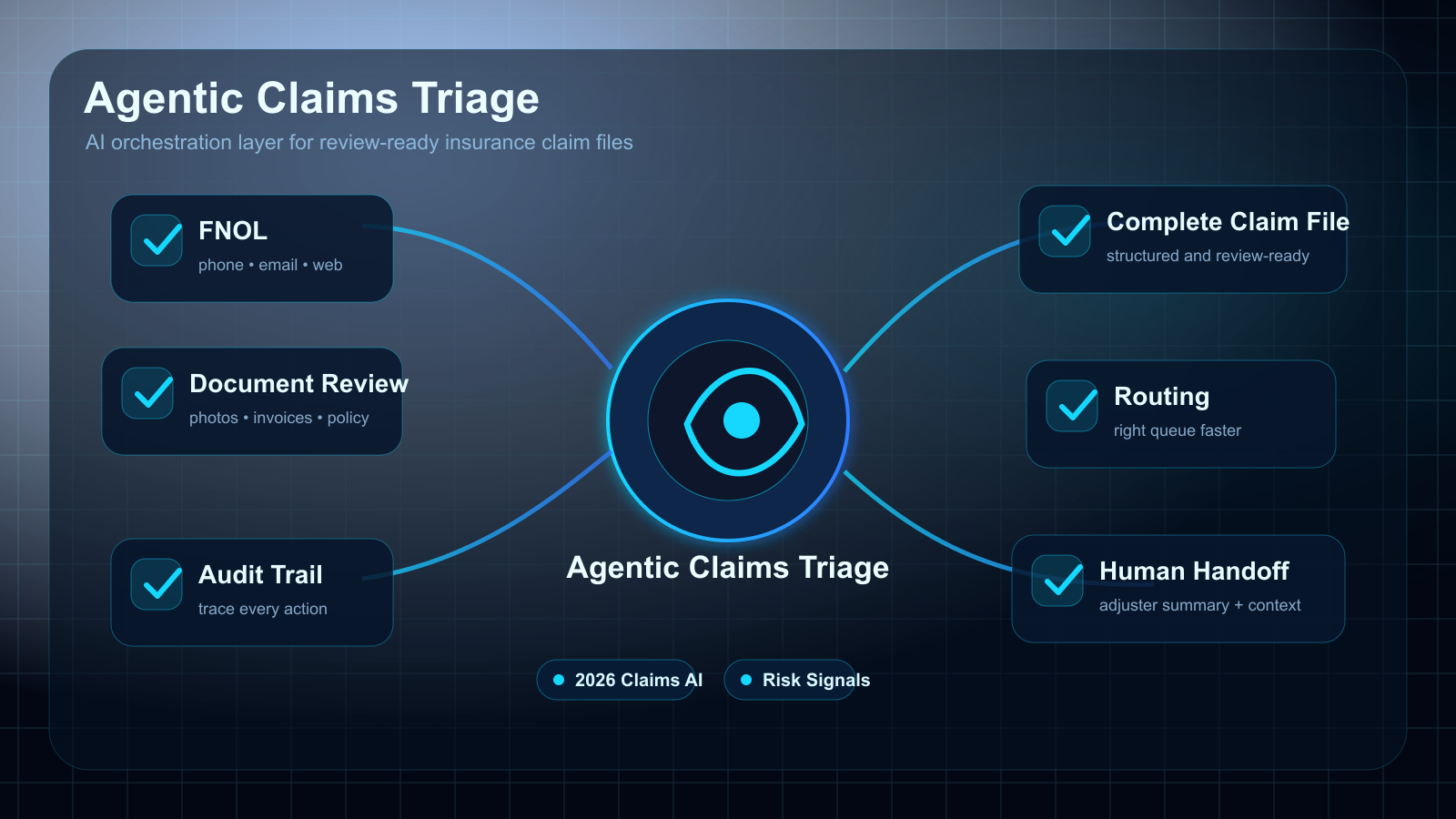
Agentic Claims Triage: How AI Automation Is Reshaping Insurance Claims in 2026
Agentic claims triage helps insurers automate FNOL, document review, routing, and adjuster handoffs while keeping humans in control.
Related Articles
Continue learning about insurance automation

Get More Insurance Automation Insights
Join 500+ insurance agency owners receiving weekly automation tips, ROI calculators, and industry insights.
No spam. Unsubscribe anytime.